 Author :

A digital credentialing service provides you with a platform capable not only of issuing secure, valid, and verifiable certificates but also of storing and tracking them over time. For instance, a university or an e-learning platform may need to roll out many digital certificates every day. This task is repetitive and prone to error when performed manually. Also, universities, colleges, and other organizations usually print physical certificates, which makes certificate issuance even more time-consuming and costly.
However, a digital credentialing service enables the issuance of a complete electronic document that can be delivered to the recipient instantly and can be verified instantly. Moreover, the software also automates the certification issuing process, enabling hundreds or even thousands of issuances with just a few clicks.
Key Features and Benefits of a Digital Credentialing Service
These features define a digital credentialing service and the benefits it offers over traditional certification methods. They are:
User-friendly Interface
The easiest way to judge a digital credentialing service’s user interface is to use the product yourself. Create a trial account or ask for a live demo and try issuing a credential without reading instructions. If you can’t create, issue, and send a credential within a few minutes, the interface is likely too complex. Core actions should feel obvious, not hidden behind multiple menus.
A good UI should also work for non-technical users. Give access to someone on your team who isn’t product-savvy and see if they can issue a credential confidently. Finally, check the learner experience: the credential should open cleanly on mobile, load quickly, and make verification and sharing to LinkedIn simple.
Security and Verification
A good digital credentialing service should ensure that once a credential is issued, its contents cannot be altered without detection. In practice, this is achieved through cryptographic signatures that bind the credential’s data—such as the issuer, recipient, and achievement details—into a secure, verifiable record. If any part of that data is changed later, the credential no longer validates.
Some platforms go a step further by anchoring credential fingerprints to blockchain ledgers, creating an additional, immutable reference point. The ability to reliably detect tampering is what separates a true digital credentialing service from a system that simply issues digital certificates.
Integrations
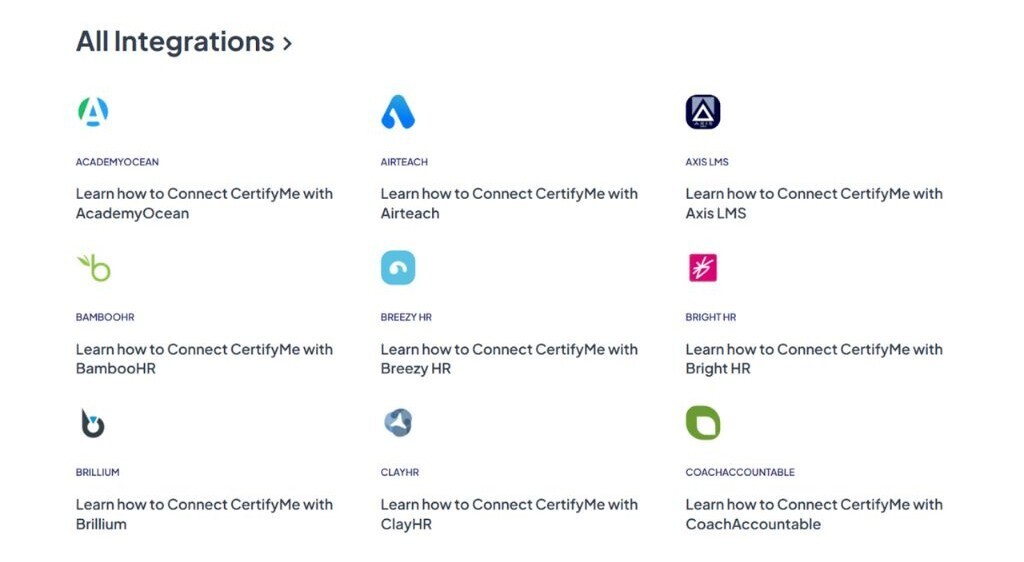
A digital credential platform must integrate with existing workflows or may need to do so in the future. Hence, integrations become an important feature for a digital credential service to provide. Integrations enable easier data transfer and reduce the risk of errors. Most digital credential service providers offer a platform that integrates easily with workflow tools such as CRMs, LMSs, and HR management systems.
Digital Credential Manager or Dashboard
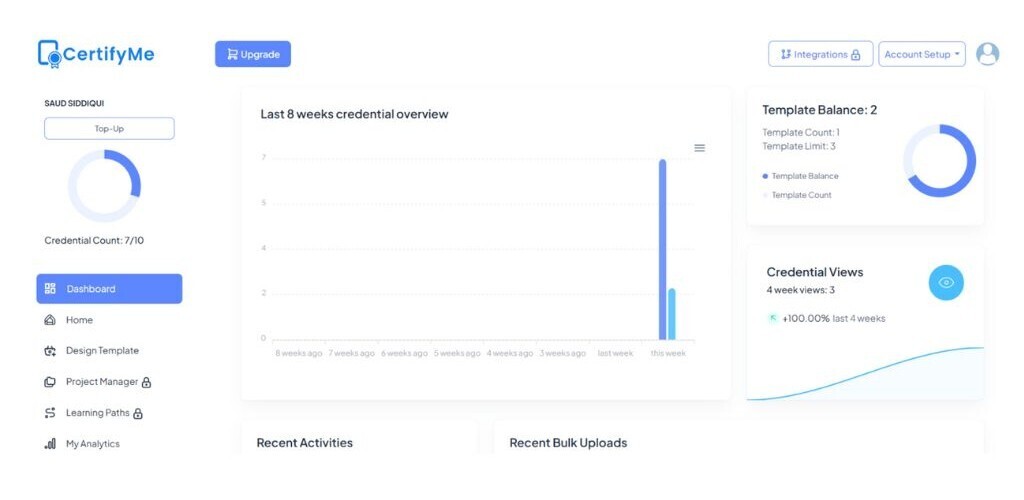
A digital credentialing service offers a complete digital certificate journey, which is why the platform must include a dashboard to manage all issued credentials. The dashboard usually provides analytics on all digital certificates, such as the total number of views and social shares, and helps you access details for individual certificates and their recipients.
Customizable Templates
A digital credential is more than just a statement of fact that someone has achieved or developed a particular skill. It is also an opportunity to enhance your brand visibility, made possible by customizable templates. A good digital credential platform lets you customize your digital certificates and white-label them with your brand identity. For instance, use your brand colors, font, and logo to create digital certificates that help others instantly recognize your brand when they share it online.

Scalability
Many tools work fine for small batches, but start to struggle when you move from issuing dozens of credentials to issuing thousands, across multiple programs, teams, and regions. A scalable platform should support bulk issuance (CSV imports or API-based issuing), handle spikes in traffic, and keep the learner experience fast and reliable even at high volume.
In real-world rollouts, scalability also means operational control. Look for features like role-based access (so different teams can manage their own programs safely), reusable templates with versioning (so changes don’t create confusion) and audit logs (so you can track who issued what and when).
Conclusion
Understanding what a digital credentialing service actually does helps you make better decisions as your credentialing needs evolve. Whether you issue certificates today or are planning something more advanced, the key is knowing what to look for—usability, security, scalability, and long-term reliability—before committing to any system.
If you want to see how a modern digital credentialing service works in practice, the simplest way is to experience one. You can explore a sample credential to understand the learner and verifier experience, or create a free CertifyMe account to issue a test credential yourself. If you later find yourself evaluating digital credentialing at scale, request a live demo with the CertifyMe team to help you assess whether it fits your specific requirements.