


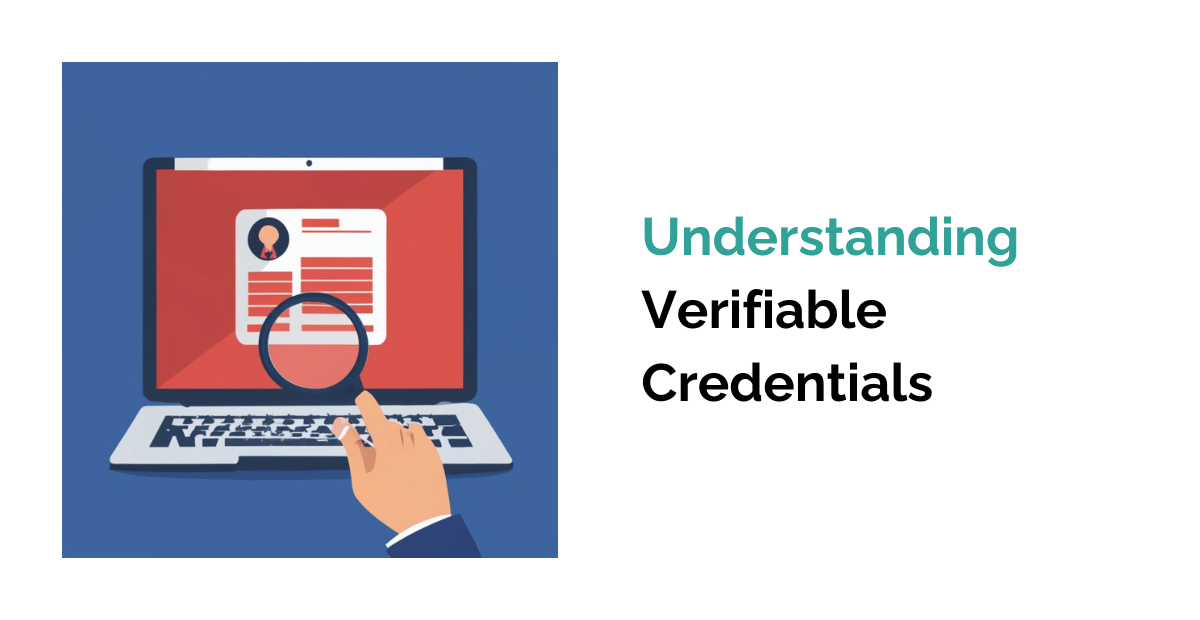

Verifiable credentials are structured issuer statements with a supported securing mechanism. Understanding them starts by separating the claim, the proof and the verifier’s policy decision.
Three layers to read
The claim describes the subject and achievement. The proof mechanism supports integrity/signing-authority checks. The verifier’s policy determines whether the issuer and claim are suitable for the intended use. None of these layers should be silently substituted for another.
The issuer–holder–verifier workflow
An institution issues a course-completion achievement. The learner presents it to a receiving organization. The receiver checks the supported proof and relevant issuer/status resources, then decides whether the achievement meets its own requirement. Independent identity assurance is a separate process.
Read the model rather than the marketing shorthand
The W3C data-model authority guide explains roles and boundaries. It does not require one universal proof mechanism or establish every participant’s authority.
Connect the achievement context
An Open Badges achievement credential describes an achievement within the related standards context. A Comprehensive Learner Record can connect multiple achievements with their provenance.
Prepare the operating responsibilities
The institutional credential lifecycle assigns approval, issuance and maintenance. Ask about export, key/status continuity, access to evidence and supported recipient/verifier behavior before procurement.
Know the limits
Standards can reduce dependency on a single presentation format, but verification may still require issuer resources. A credential can have a valid proof and an unsupported or inappropriate claim. Do not promise universal interoperability, fraud elimination or privacy merely because a credential is digital.
Plan your next step
See how CertifyMe’s structured credential records support your institution’s awards and verification workflows. Request an institutional demo.
Frequently Asked Questions
Is verifiable the same as independently true?
No. Supported proof can establish integrity and signing authority; the issuer, assessment and claim still need policy review.
Must we contact the issuer manually for every verification?
Not necessarily, but keys and applicable status resources may remain issuer-dependent. Check the actual implementation and continuity arrangements.